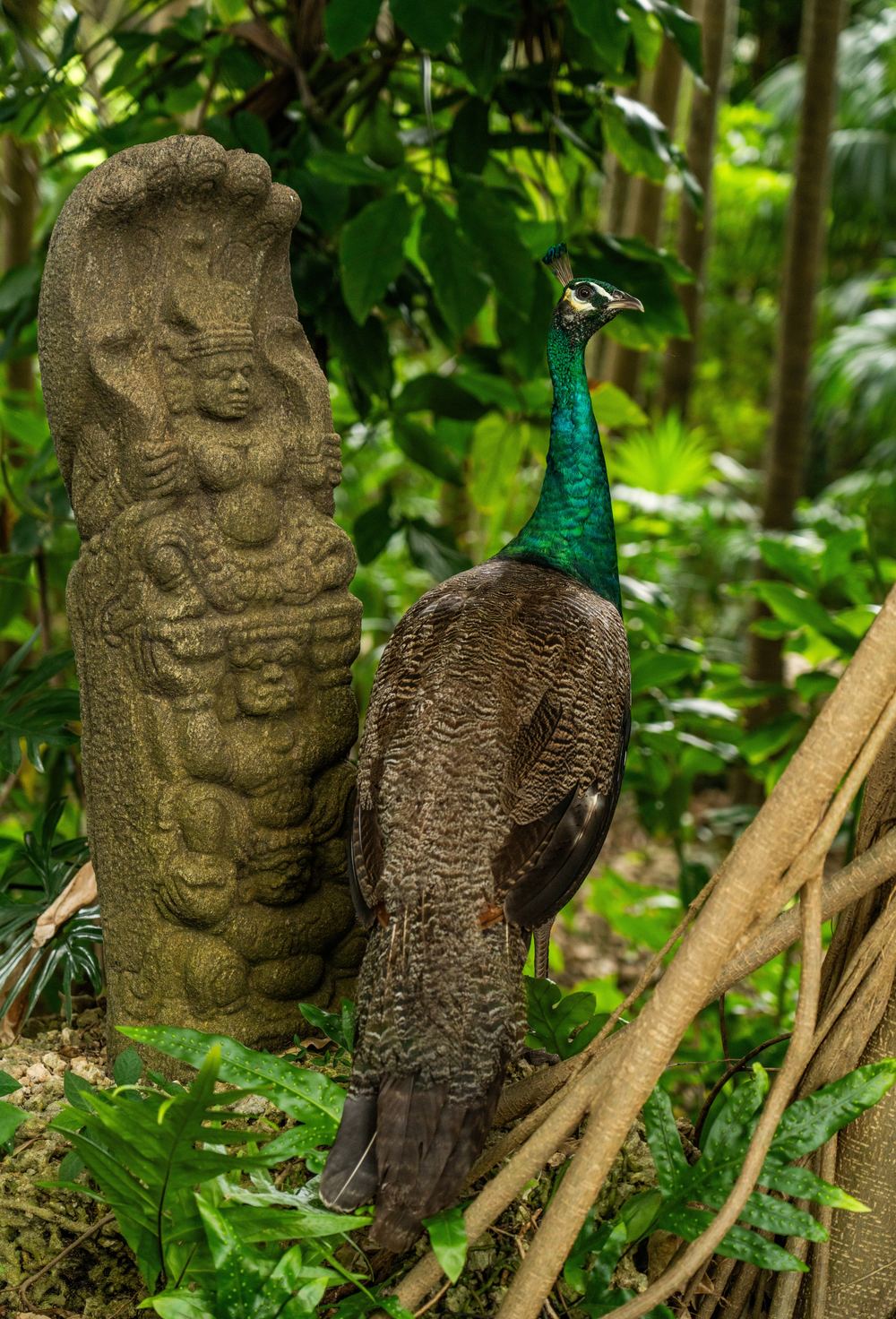
A peacock stands beside a century-old carved stone figure at The Kampong, a 9-acre botanical garden tucked into Coconut Grove, Miami's oldest neighborhood. A few miles west, in the part of the Grove historically known as Little Bahamas, a community founded by Bahamian settlers before Miami was even a city is still fighting to fund a museum honoring its own history. Both are Coconut Grove. Neither gets much attention from the other.
The garden business
The Kampong was founded in 1916 by David Fairchild, a plant explorer who spent decades traveling the world, mostly through Southeast Asia, collecting and importing roughly 30,000 plant species into the United States, including avocados, quinoa, and Japanese cherry blossoms. He named the estate Kampong, a Javanese word for village, and built a house that blends Spanish and Southeast Asian architectural influences, which explains the garden's distinctly Asian-inflected sculpture and design. It is now one of only five gardens in the National Tropical Botanical Garden system, and the only one located outside Hawaii.
By the numbers
The Kampong isn't the only cultural anchor doing quiet, steady business in the neighborhood. Vizcaya Museum and Gardens, a Mediterranean-style estate with European-style gardens a short drive away, and the long-running Coconut Grove Arts Festival, held every year, both function as small but durable tourism and cultural economies of their own, drawing visitors who might never otherwise have a reason to stop in the Grove.
The other Grove
Before there was a City of Miami, Bahamian settlers, both Black and white, had already put down roots in what became Coconut Grove. Through the late 1800s and early 1900s, Bahamian immigrants worked as artisans and laborers on landmarks that are now considered quintessentially Miami, including Vizcaya itself and much of Coral Gables. The western part of the neighborhood became known as the Black Grove, a hub of civil rights activity and political organizing for much of the 20th century.
Gentrification and economic pressure eroded much of that community over the following decades, and in 2022, the City of Miami formally designated the area Little Bahamas of Coconut Grove, an official recognition of its history. U.S. Representative Frederica Wilson helped secure $2.2 million in federal funding toward an arts and culture museum planned for the West Grove, intended to do for that history what The Kampong and Vizcaya already do for Fairchild's legacy: give it a physical place people can actually visit.
Bahamian settlers built Vizcaya. Their own neighborhood is still working to fund a museum about it.
Business, lifestyle, and what holds it together
Coconut Grove's identity as a neighborhood, sailing capital, bohemian enclave, home to free-roaming peacocks, waterfront parks, is inseparable from its economics. Real estate values along the bayfront and near The Kampong and Vizcaya trade heavily on that identity. The unresolved question is whether the same neighborhood can hold onto the other half of its history, the Bahamian half, with the same level of investment and permanence.
What to watch
- Whether the $2.2 million in federal funding for a West Grove arts and culture museum survives the planning process into an actual building.
- Whether gentrification pressure in the West Grove accelerates or slows as Miami's broader real estate boom continues.
- How a future West Grove museum's visibility compares to established draws like The Kampong and Vizcaya once it opens.