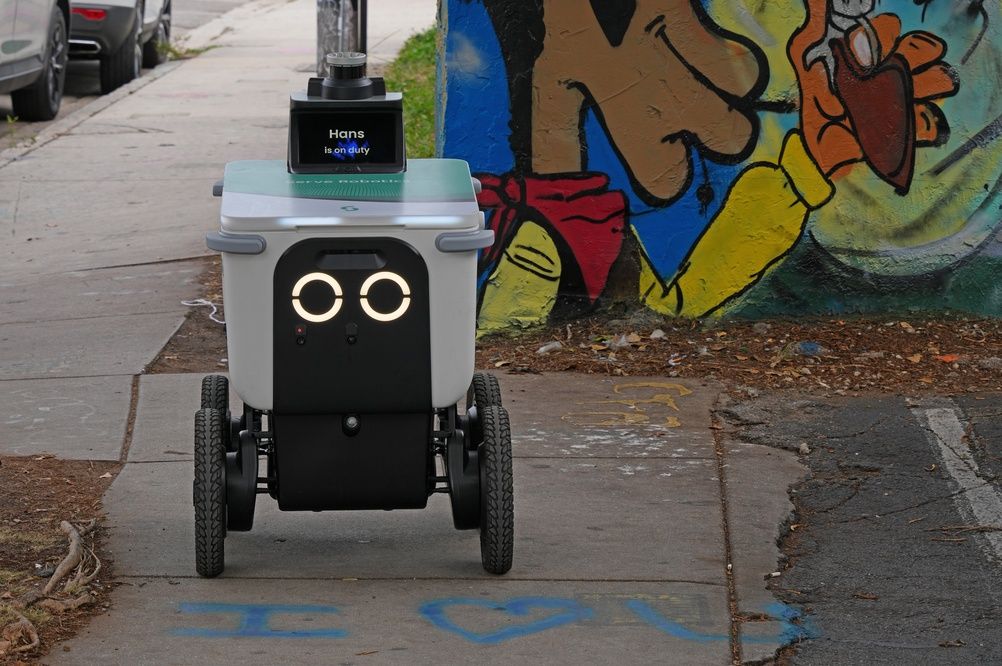
A four-wheeled robot named Farnoosh rolls down a sidewalk in Brickell, carrying someone's Uber Eats order, while a woman named Yudidx stops to smile at it. This is not a novelty anymore. It is a real, if quietly small, logistics network that has been rolling out across Miami's densest neighborhoods for the past few years, run almost entirely by companies that were not founded here.
Why it matters now
Sidewalk delivery robots have moved from pilot projects to a genuine, if early, industry. More than 18,000 sidewalk delivery robots were operating across the U.S. by the second quarter of 2026, more than triple the number a year earlier, spread across a handful of companies: Serve Robotics, Coco Robotics, Starship Technologies, Cartken, and Wing. Miami, and specifically Brickell and Miami Beach, was one of the first markets outside California where this actually happened at scale.
By the numbers
Who's actually running them
None of the companies operating robots on Miami's sidewalks today were founded in Miami. Serve Robotics, the most visible operator, spun out of Uber and Postmates in 2021, is backed by Uber, Nvidia, and Delivery Hero, has raised roughly $220 million, and now trades publicly on the Nasdaq. It launched in Miami in early 2025 through Uber Eats, partnering with Shake Shack and a local pizza chain, and expanded into Fort Lauderdale by the end of that year. Coco Robotics arrived separately in 2025, starting in Wynwood and Downtown Miami. For all of them, Miami is a deployment market they chose, not a headquarters they built.
Company Snapshot
- Founded
- 2013 in Miami, originally as a parking-lot technology company called ParkJockey
- Peak scale
- Raised $1.5 billion from SoftBank and Mubadala; launched Miami's first delivery robots with partner Cartken in 2021
- What happened
- Reportedly burned roughly $30 million a month beyond revenue at its peak, cut 750 jobs in a single 2022 round of layoffs, and faced repeated regulatory shutdowns of its ghost-kitchen operations in multiple cities
- Today
- Refocused on its original parking business; most of the robots now visible on Miami's streets belong to unrelated outside companies
The company that first put robots on Miami's streets barely survived trying to sell pizza, not robots.
Is anyone in Miami actually building the robots?
There is at least one small, homegrown answer: Earth Robotics, a Miami-based startup founded in 2020 that builds autonomous delivery robots for food and parcel logistics. It is a fraction of the scale of Serve or Coco, having raised roughly $130,000 to date. For now, Miami's role in this industry looks less like a manufacturing hub and more like a willing test market, a city where regulators, restaurants, and pedestrians have all been open to letting outside companies try something new on the sidewalk first.
What to watch
- Whether Serve Robotics' national expansion, aiming to double past its first 1,000 robots, meaningfully grows beyond Brickell, Miami Beach, and Fort Lauderdale.
- Whether any Miami-founded robotics company scales the way REEF once did, before REEF's own ambitions ran into trouble.
- How sidewalk crowding and accessibility concerns shape local rules as more operators enter the market.